

Why choose The Henry Beaufort School?
10% of students leave with 11 or more grades this is three more than most GCSE students’ study
55% of students leave with 10 or more, two more than most GCSE students’ study
87% of students leave with 9 or more, one more than most GCSE students’ study
Why do our high attaining students take 9-11 GCSE’s?
Well, these are able students who need to be stretched and challenged.
They leave our school with qualifications that set them up for post 16 studies and Russell Group universities.
Students are able to take GCSEs in their heritage languages beyond their courses studied here including Arabic, Chinese, French, Mandarin, Persian, Russian, Polish, and Spanish
Our school offers a triple science pathway with 65% of students undertaking the triple route within the science curriculum
17 of our students attained a Grade 9 in further maths to prepare them for studying maths at A-level.
We are the only school in the area to offer GCSE engineering
The Henry Beaufort School is a very successful school.
We have a five-year curriculum model, and our options process begins in Year 8. We believe that this will give all of our young people the opportunity to secure the best possible outcomes, academically and in terms of their personal growth.
Cultural capital opportunities throughout the five-year model are integral to this success and this ensures that we continue to offer a broad and balanced curriculum throughout the five years of secondary school.
Our young people are known for their independent learning skills, that enables them to be successful at college and university.
THE HISTORY OF OUR
NAME AND CREST

The Henry Beaufort School was opened in September 1971. The school bears the name of a Bishop of Winchester who died in 1447. Henry Beaufort was Bishop of Winchester and three times Chancellor and is buried in Winchester Cathedral. He was a highly regarded representative of his country abroad.
Henry Beaufort was also a man of great wealth but he gave large amounts to charity, including rebuilding Winchester Cathedral and enlarging St Cross Hospital. We consider our students to be members of the wider community and it is hoped that all of them will aim to be good representatives of the school ‘abroad’ – both in the locality and further afield. It is also hoped that they will share what good fortune they have with other members of the community. For these reasons the school governors chose the name of Henry Beaufort for the school. The school crest represents Beaufort Castle in Anjou, France, from which Henry Beaufort took his name.
FACULTIES
In order to echo this connection with other countries and cultures, and looking forward to other European links through our International School award, European cities have been chosen as names of the seven faculties. Each of these cities has a connection with the curricular team to which it is linked.
Athens: The Physical and Expressive Arts; Berlin: The Humanities; Luxembourg: Modern Languages; Moscow: Mathematics; Prague: English Language and English Literature; Rome: Technology; Warsaw: Science and IT. Apart from the Expressive Arts and PE who are led by individual Heads of Department, each faculty is led by an Academic Leader.
The Henry Beaufort School Vision Statement
We are proud to be an inclusive comprehensive school. We understand that young people today have many pressures placed upon them from an early age. Our role is to create a happy, stimulating learning environment that gives every child the confidence and resilience to face these pressures head on.
We have high expectations of all of our students. At The Henry Beaufort School there are no limitations to individual success.
We acknowledge the fundamental role that we play in the academic and moral education of young people.
We celebrate the success of our students at every opportunity and take delight in the buzz and energy around the school site well beyond the official ending of the school day.
We do not accept mediocrity or complacency. We understand the challenges that accompany our role as educationalists and we continue to work to find ways to refine and improve our practise. This is underpinned by our aim to be outstanding in everything that we do.
THE SCHOOL DAY & ORGANISATION
The school day is compressed, running from 8.25 am until 2.55 pm, with a fifteen-minute morning break and a half-hour lunch break.
Years 7, 8 & 9
The model for these year groups ensures a broad and balanced coverage of different curriculum areas. Within Humanities, three different subjects are taught: History, Geography and RE, hence their higher allocation of time.
Years 10 & 11
At this point in a student’s education, the curriculum narrows in terms of breadth, but deepens in terms of subject knowledge, as students spend significant proportions of their time (20 hours per fortnight) on their four chosen subjects. Alongside their options, the highest proportion of their time is spent in the three core subjects: Maths, English and Science.
Personal Development Days happen once per half term, and give the time for whole Year groups to focus on social, moral, spiritual, and cultural aspects of learning. They also incorporate the opportunity to study IT, citizenship, RE and philosophy within such topics as British Values and careers. These days ensure that students develop as well rounded and characterful individuals with a range of experiences outside traditional subjects.
Curriculum
Map
All subjects have a “Learning Journey” which can be accessed in more depth by looking in each subject area on our website. Please note that each 5-Year Curriculum map exists in a bespoke format for that subject. Curriculum offers differ greatly from subject to subject, and Academic Leaders have built a model that best suits the nuances of their subject.
Pastoral Organisation
Heads of Year take overall responsibility for attendance, behaviour, rewards, sanctions and progress of their respective year groups.
Head of Year 7 -Mr Janes
Head of year 8 – Miss McMahon
Head of Year 9 – Mr Davidson
Head of Year 10 – Miss Bean
Head of Year 11 – Mr C Naisbitt
The Senior Leadership Team Structure
Headteacher – Miss S Hearle
Deputy Headteacher – Mr A Applin
Deputy Headteacher – Miss E Shelton
Assistant Headteacher – Miss E Colebourn
Assistant Headteacher – Mrs H Briggs
Bursar – Ms A Caplin
ACCOMMODATION & RESOURCES
Our Building And Facilities
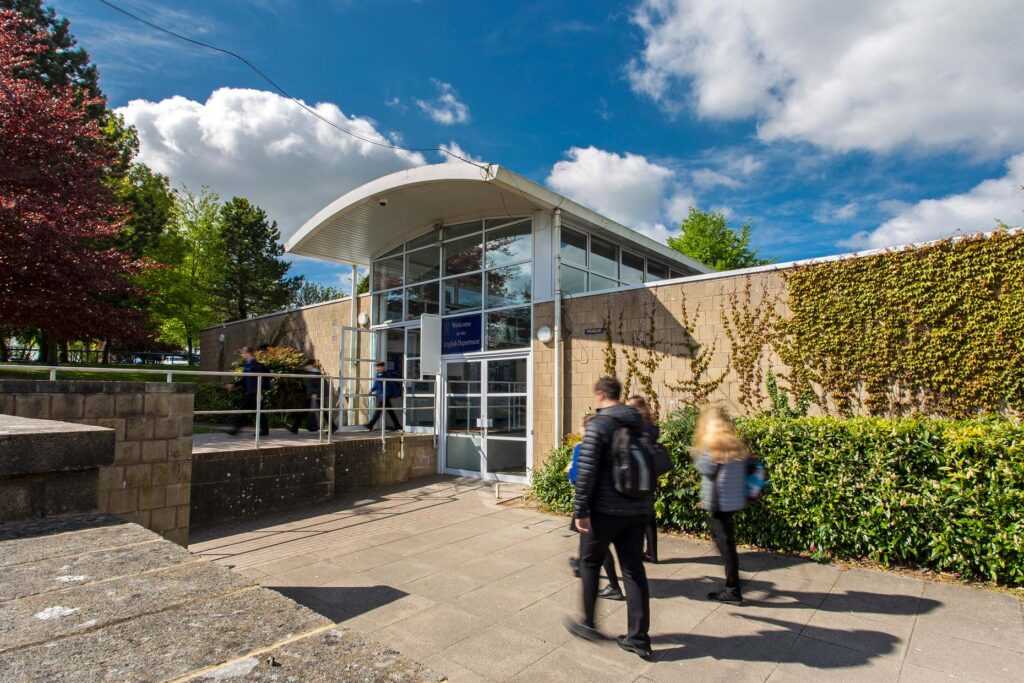
The School consists of eight main buildings around the central administration block (Winchester). The facilities include:
- Library;
- Four Information Technology Suites;
- Media suite;
- Eight Science Laboratories;
- Beacon Arts Centre which has excellent Drama facilities, Art Studios, and Music rooms;
- Gymnasium;
- Dance Studio;
- Sports Hall;
- Design and Technology Workshops;
- Learning Support;
- Hearing Resource Base.
For outdoor sports and athletics, there is an extensive area of grass as well as hard playing surfaces. The Sports Hall is used for Whole School Assemblies and also affords facilities for a wide variety of sporting activities.
The Library is available for use by students at all times of the school day. Students may book in to use any facilities not otherwise in use, to assist their work. In addition, all these resources, including the computers, are available for use at certain times after school for a variety of other activities.
Want to find out more?
Get in touch with the school with
any query you may have